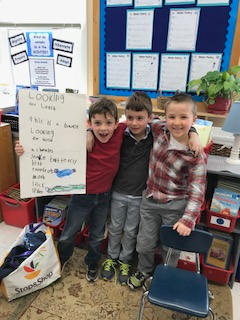
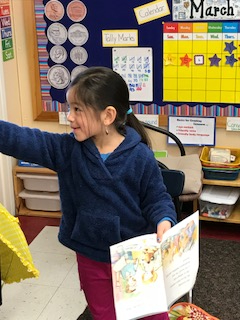
Friday, March 30, 2018

'AROUND THE WORLD' AND BOOK CLUBS...in First Grade

You Are Now Free To Move About The Iceberg:

The First Graders Take a Plane Trip To Antarctica!
Fasten your seat belts. Please return your penguins to their full and upright locked positions. First Graders are about to land in Antarctica!  Our recent plane ride had the First Graders loading a plane bound for Antarctica, the continent they are currently studying. Our fearless pilot and co-pilot led the way, reminding their first grade passengers to buckle up for safety.

Thank you to our brave pilot and co-pilot, who flew our plane to Antarctica!
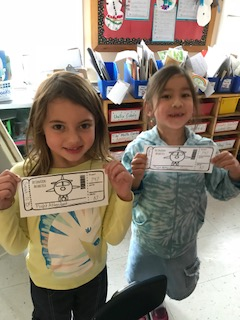

First Grade Ticket Takers made sure they
collected every ticket, and the First Grade
Flight Attendants had a job to make sure
every passenger was as comfortable as
they could be.
This involved passing out snacks and water.
After all, it takes a long time to get to
ANTARCTICA!
While the First Graders are in Antarctica, they will be learning about the
continent, weather/temperature and emperor penguins!

First Grade Book Clubs

In March, First Graders also participated in Book Clubs. Each Book Club spent a
week reading their book together with a teacher, focusing on the story elements
of characters, setting, problem, and solution. As a culmination, students then
brainstormed ideas for a Book Club special project. Each group decided on an
idea, made lists of items needed and gathered materials to complete their project.
Book Clubs helped bring books "alive" through a puppet show, a play, diorama, a
pop-up book, advertisement poster and special art projects.
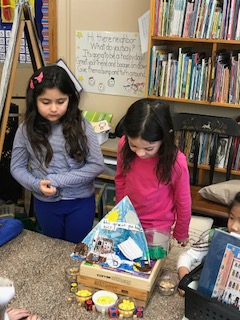


The First Graders loved participating in book Clubs
and presenting their projects!


Sunday, February 4, 2018

Literacy Stations in First Grade


Tune Into The Literacy Station In First Grade!

by Charly Weiss and Kate Treat

A first grader's favorite station isn't Nick Jr. or Disney Jr.  It's a station right in their own classroom!
The new year brought several new things in first grade, including the start of Literacy Stations!
Literacy Stations are activities and lessons that provide focus on a particular literacy skill.  
Each day the students spend time at one station, and then rotate through 5 stations over
the course of 5 days. Here are some examples of Literacy Stations in First Grade:
       
  • Fluency Station
  • Sight Word Bingo Station
  • Handwriting Station
  • Word Sort Station
  • Working With Words Station (students work directly with Mrs. Hornyak)
  • Teacher Station (students work directly with Mrs. Treat and Mrs. Weiss)
  • Lexia station (students work with the reading program Lexia)
       
2 First Graders practicing fluency by reading a story together. 
The story they are practicing has 2 alternating character parts.


Word Sorts are great practice to reinforce concepts learned in class like
blends and digraphs.

The First Graders always love to work with Mrs. Hornyak!

Sight Words make reading easier. Sight Word Bingo is a great way to practice!


The Lexia station allows students to work with the reading program Lexia, where they
can work independently at their own pace.


The Handwriting Station is a great place to practice letter formation.


2 First Graders, at a teacher station practicing reading "Just Right Books," and
making (or as we like to say 'baking') words with the 'vowel - consonant - silent e'
pattern with magnetic letters and baking sheets.

Literacy Stations provide the opportunity for First Graders to grow as readers and
writers every day!

Ask your First Grader how they're enjoying tuning into reading at the Literacy Station!

Sunday, January 7, 2018

1st Grade Research Project: Hibernation, Migration, and Adaptation

The Secret Life of Bears: Hibernation, Migration, and Adaptation


Have you ever wondered what happens to animals in winter? Where are all the bees, hummingbirds, frogs, and turtles? In first grade at TCS, the first graders have embarked on a research project, and are studying how animals adapt to colder conditions when food is scarce by entering into a state of hibernation. The students are learning how these hibernating animals’ hearts and breathing rates slow down and body temperatures drop. Hibernation offers these animals a special adaptation that helps them conserve their energy. Another way animals respond to changes in temperatures and seasons is by migrating or adapting in some way. Some animals that are “true hibernators” are bees, snakes, bats, and woodchucks. Surprisingly, bears are not “true hibernators!” They do go into a deep sleep, but occasionally they might wake up to have a snack or take a walk on a sunny day!


Add caption

To kick off our big research project about these animals, the first graders each picked an animal they were interested in learning more about and chose a book to use for their research. Off we went to the library, where Mr. Robertson helped us find books about our animals. The first graders used their books and other online resources to find out information about their animals, such as what it eats, where it lives, interesting facts about their animal, and what it looks like. Of course, the big question they had to find out was, “Does my animal hibernate, migrate, or adapt?” 

These first graders are proudly displaying the animals they chose: 


The first graders were hard at work finding out information about their animals. The students learned how to use a “Table Of Contents” to find information they were looking for. They also used graphic organizers to help keep track of the information they found. Sometimes research requires us to work together:


Sometimes information we are looking for can’t be found in our books, so we turn to online resources to try to answer the questions we have:


The first graders will use this research project as a springboard for our study on emperor penguins and Antarctica. Soon we will be packing our bags for our trip to Antarctica to study these amazing birds, who survive the Antarctic ice and its waters by relying on many clever adaptations!


Saturday, November 4, 2017

Nature, Pumpkins, Math and more...

"Where a Leaf Will Land, Only the Wind Knows..."


In first grade we love to use outdoor education as a way to learn about the world around us. So on a beautiful fall day, we set off on an "Observation Hike" around the TCS campus, where we observed worms, butterflies, grasshoppers, dragonflies, and bees, and even a katydid! The campus was buzzing with life!


The first graders also embarked on a leaf hunt, and collected as many different varieties of leaves as they could find. The students took time to try to identify the different leaves: we had sassafras, red maple, oak, american beech, and more! The students made leaf rubbings, and listened to the story Leaf Man by Lois Ehlert. In this book, Lois Ehlert creates a Leaf Man as well as many other animals made entirely of leaves. Leaf Man's eyes are acorns and his mouth is a seed pod. He travels over garden vegetables, past prairie meadows, and over lakes and rivers. As Lois Ehlert repeats in her book, "The Leaf Man goes where the wind blows." The first graders took their gathered leaf collections and created their own animal creations, just as the author did in her book. It took some imagination to discover which leaves looked like chicken's legs, or whale's fins, or fish swimming in the ocean! Come see them in our classrooms when you get a chance!


In October, first graders also dove into pumpkin carving! In STEAM you could find the students carving eyes, noses, and mouths, and even cutting off the top of a pumpkin and scooping out the insides (because it's interesting to discover what's in there)! The students also used pumpkins for math by weighing pumpkins and measuring the circumference. Because it was Halloween, Mrs. Lariviere even concocted a scary witch's brew, complete with a floating eyeball (see picture)!


Inside the classroom, first graders are equally busy. Our current math unit focuses on number bonds, which provide a visual representation of the relationship between a number and the parts that combine to make it. Students are learning how to tell an addition story, and use their stories to make number bonds and addition sentences. As the students explore addition in first grade, they learn how to make sums in many ways. Here are the students figuring out how to make the sum of 10 in different ways.


We are looking forward to a busy November with lots more learning! We will be studying Native Americans and taking a voyage on the Mayflower!

Saturday, October 7, 2017

Nature and Science in First Grade - Bringing the 'outdoors' indoors...

What's in our tank?

First Graders were excited to discover what was in our
classroom tank when they arrived at school.
With peering eyes and whispering voices, they soon spotted
a very tiny larvae on a large green leaf and a very tiny egg.

Can you guess what was in our tank?

First Graders have been great observers as they watch and learn about
Metamorphosis and the life cycle of the Monarch Butterfly.
The four stages of the monarch butterfly life cycle are 
the egg, the larvae (caterpillar), the pupa (chrysalis), and the adult butterfly


caterpillar
chrysalis


Monarch Butterfly

Be sure to ask your child how to tell Male
Monarchs from Female Monarchs.


We have released 3 butterflies and we have 
4 chrysalises in our tanks.